David Story, Online Piano Lessons from Toronto
  • Homepage
  • Tips, Ideas, Stories, Free Lessons
  • Contact form, fees, calendar, policies
  • Adult Lessons
  • About Me
  • Children Lessons
  • Jazz and Blues Workshops 2024 2025
  • Philosophy
  • Testimonials
  • Student awards and compositions
  • Classical downloads
  • Classical outline for beginners
  • Jazz and Blues Downloads
  • Jazz outline for beginners
  • Children's Piano Recital
  • Video Library of Piano Techniques
  • Breakfast Piano Minute
  • Books, Apps, Websites, Music
  • Ear Training and Sight Singing Resources
  • My YouTube channel
  • Chord Voicings for Jazz Standards
  • Long and McQuade Teacher Workshop 2024

Tips, free lessons, and inspiration

Practice notes for an intermediate jazz piano student

1/22/2025

0 Comments


This is the homework assignment for a current student. She plays regularly with a bassist in the Toronto area. She is aiming to build her jazz chops and sophistication at the piano. I'm encouraging her to abandon the books and embrace the ear. 

Play list: 

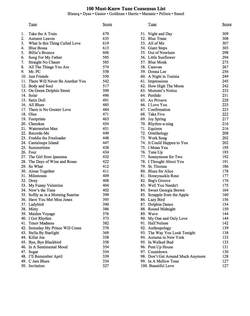
Sweet Georgia Brown
Satin Doll
Mac the Knife
Rhythm Changes
All of Me
A Train

Ways to practice. Make a playlist of 3 to 5 versions of each song on YouTube. Then...
 
1. Play the melody with the track. Adjust the lead sheet to fit what is going on. 
2. Comp the chords along with the recording. 
3. Solo overtop of the recording. Copy short licks you hear. What you hear will grow with repeated listening. Famed jazz educator, Ed Soph recommended listening 100 times. A little excessive, but he did turn out a legendary list of great drummers from his Texan studio. 
4. Consider making roadmaps. See the roadmap lesson refresher here. How to create a roadmap - David Story, Online Piano Lessons from Toronto
5. Compare the chord progressions found on YouTube transcriptions. For example. Sweet Georgia Brown

​https://youtu.be/NFzHvuaAw8M?si=XEVCkZHksIsJeqZp 
https://youtu.be/rtol5kOngMI?si=dhvTfqPFWn3-sCwt 
https://youtu.be/R7cWDRrEgw0?si=K-qV36XRZ2LUk73A


book a class
0 Comments

Honest communication = happy productive students

1/21/2025

0 Comments


Honest communication = happy productive students

Here are some of the ways and reasons I encourage students to speak up.

1. For younger students, requesting pieces give them a sense of empowerment and confidence to request something from an entrusted adult.
2. Honest communication reduces guilt a student might feel after an unproductive week of practice. Remember, I give guilt free piano lessons. And I too take online classes, and like my students, some weeks are better than others.
​3. For teens and adults, honest communication keeps the lessons progressing in the direction of their aspirations. Furthermore, honest communication allows the student to change direction. For example, maybe you started out aspiring to earn your Grade 9 piano certificate and then realised that computer game music has more appeal.

If I can help you correct the direction of your musical progress, please reach out to me.
 
David

0 Comments

Practice Regime of an advanced jazz student

1/20/2025

0 Comments

 
This is a practice plan created for an advanced jazz piano student. (She earned her Royal Conservatory of Music ARCT as a teenager.)

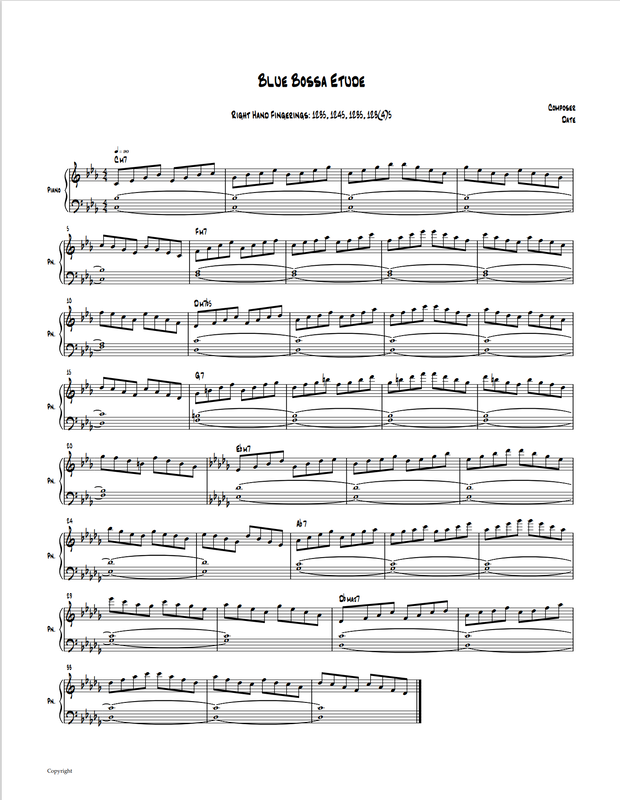
Jazz warmups and technique

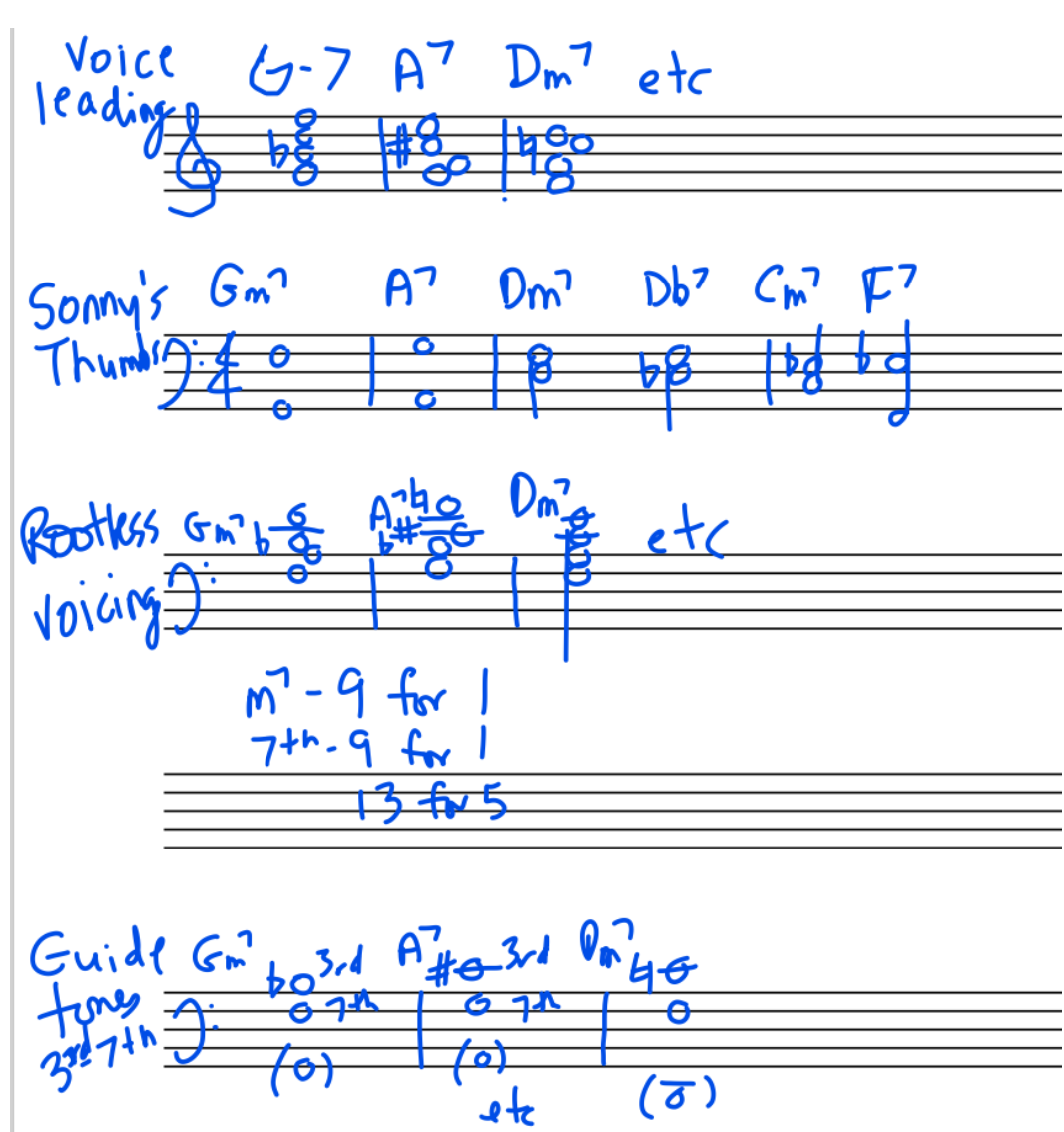
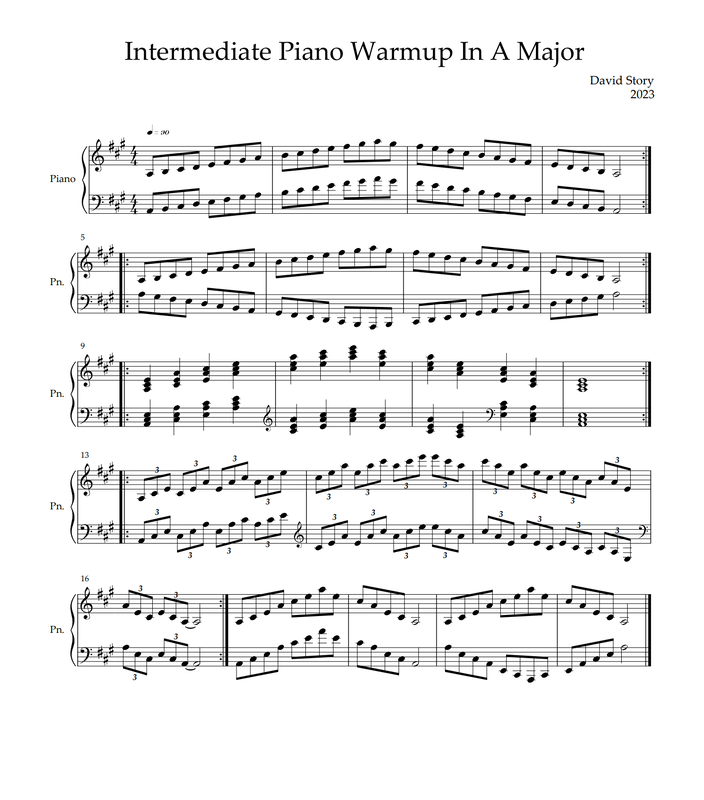
Over the course of a week, she will review the major and minor scales, modes, and left-hand voicing systems: Bebop shells, rootless chords, and occassionally modal or quartal voicings. The scales can be played straight or swung starting on the leading tone upbeat. (see below) She will play these etudes with the metronome playing on beats 2 and 4. This builds an acute sensitivity to the jazz pulse.​
Picture

Repertoire retention and development
She reviews a piece or two to retain it. Furthermore, as she learns to techniques, she can apply them to her existing repertoire. 

Aural Training
Aural or "ear" training is the most important part of practice because jazz is an aural tradition. The training jazz musicians since 1917 has revolved around playing with recordings and "stealing" or lifting interesting ideas. One exercise it to play the melody, for example Satin doll, along with the recording and try to match the rhythm. This is trickier that it sounds.

Sightreading
Randomly open the fakebook and sight read along the chords and possibily the melody to a recording. Slow the recording down if it is tricky. 

Keeping the left hand alive
Jazz piano is not kind to the left hand because in most styles of mainstream jazz it doesn't get much of a workout. So, she keeps the left hand strong by returning regularly to some favourite classical piano tunes. In her case, Chopin. (For me it is Bach. )

If I can help you design a personalised curriculum call me. I will assess your skills, consider your goals, and plan a path forward for you too. 

​David
​

0 Comments

How much should I practice?

12/27/2024

0 Comments

 
A brief, humorous, and concise summary of the quantity and frequency of practice that keeps it fun. 
0 Comments

Taking a piano exam at age 88

12/19/2024

0 Comments

 
It's very satisfying', he said. "It was fun and it was hard work, because the older you get the more difficult it is to learn things.
Picture
Watch the video here
This is a rare event, but it is possible for some folks. 
0 Comments

Doors Roblox OST Piano lesson

12/12/2024

0 Comments

 
Download the lesson
Picture
0 Comments

Adventures in Rock and Roll, Peer Teaching, and Group Learning

11/25/2024

0 Comments

 
Picture
The sociology of group learning and music making.

A short story.

Those of us of a certain age and gender remember that playing in a teenage rock band was a rite of passage. Fueled by macho TV images of rock gods playing to legions of screaming girls ignited our male imaginations. So, powered with visions of world dominance and female adoration we strapped on guitars, picked up drumsticks, and congregated in shag carpeted suburban rec rooms. The first few weeks were a bit tough because we had to weed out the hopeless, the nerds, and other misplaced uncool posers. Then we began our quest for social significance.  

Year one: We were gawd awful but enthusiastic. We began with Smoke on the Water. We argued and shared bits and pieces of the music that each of us knew and slowly stitched the thing together. (Good examples of peer-directed learning and group learning.) Now a funny downside. I remember bringing my little radio shack cassette recorder to practice and proudly recording our band. I thought that this would help us get better. Kirby, our drummer was so traumatised that he quit on the spot and was never known to have played drums again. Even worse it was his rec room, so we needed a new place to practice too.

Year two: The music started to come together. However, there were many more personnel changes over disputes around commitment to the band, artistic differences, and widening skill levels.

Year three: We played in public for the 1st time. Thankfully this was before social media and cell phone video. So, in my memory we had become formidable rock gods. I'm sure the reality was different. 

Year four: I’m at Berklee College of Music in Boston and the rest is history.

Postscript.

A few of us from North Bay made it in the end. One of us, the late John McGale, even became a certified rock star and guitar god. And yes, music did take me around the world though not as a rock star. 
 
If you would like to start your quest, call me, I'll teach you to play. When we started out we thought lessons we optional. Our 13 year old minds thought, "how hard can this really be when it looks so easy on TV?"

Reference
"How Popular Musicians Learn" by Lucy Green, Routledge Press, 2002
0 Comments

Effective Practice Strategies 2024 For Teenagers

10/6/2024

0 Comments

 
1. What is the difference between learning and practicing?
2. What claim does the writer make about the connection between happiness and growth? 
3. Make a list of his "how to get better by practicing less." tips. For example, how does he recommend structuring your time on the piano bench?

Note: I would take some time practicing sight reading; the skill that makes it possible to play easy pieces without practicing!
1. What is the purpose of practice?
2. What happens in our brain when we practice?
3. What is meant by the "edge of our abilities?"
4. What is visualisation in practice?
0 Comments

Eudaimonia, Digital Distractions, and Practicing

9/19/2024

0 Comments

 
​As adults we understand that digital distractions do not promote, support, or maintain eudaimonia or human flourishing. Prescriptions for promoting self-regulation are beyond the scope of this writer, however each of us, in our own ways, must consider this problem, if we are going to free up time to practice and reach our goals of learning the piano. Let me share some strategies I employ.  

I accept that to develop as a musician will require me to say no to many kinds of distractions, digital and otherwise.  Also, I have also come to peace with the fact that learning to play is a process that has peaks and valleys.  

With that out of the way here is my strategy. 

1. Each August I plan my year in advance. I block out family time, personal time, holiday time, and practice time on the calendar and then I book in my students. How many students I accept is constrained by these boundaries.  This is the major thing I do. I restrict the time available to be distracted. 
2. I try to keep my stress level at a manageable level. When my stress goes up distractions will rush in and swamp my best intentions. 

Happy Practicing.    

David 

References  Eudaimonia | Definition & Facts | Britannica 

Further reading and listening 

1. Newport, C. (2022, November 18). Deep questions podcast by Cal Newport. The Deep Life by Cal Newport. https://www.thedeeplife.com/listen/  Digital distractions Podcast. Newport is a professor of Computer Science at Georgetown University. He has chronicled his journey earning tenure, publishing academic papers, raising a family, staying married, and writing a string of best sellers on digital distraction.  

2. Yufei Qiu, Xueyang Zhao, Jiali Liu, Zhaoyang Li, Man Wu, Lixin Qiu, Zhenfang Xiong, Xiaopan Wang, Fen Yang, Understanding the relationship between smartphone distraction, social withdrawal, digital stress, and depression among college students: A cross-sectional study in Wuhan, China, Heliyon, Volume 10, Issue 15, 2024, e35465, ISSN 2405-8440,https://doi.org/10.1016/j.heliyon.2024.e35465.   (https://www.sciencedirect.com/science/article/pii/S240584402411496X) 

Abstract: Background 
Smartphone distraction considerably affects the depression level of college students. These two variables are highly associated with social withdrawal and digital distress. However, the underlying mechanisms of how social withdrawal and digital stress were involved in the relationship between smartphone distraction and depression remain unclear. 

Methods 
A cross-sectional survey was conducted in seven colleges of Wuhan, Hubei Province, from September to November 2021. Participants were selected using convenience sampling. Smartphone distraction, social withdrawal, digital stress, and depression level were assessed using the Smartphone Distraction Scale (SDS), 25-item Hikikomori Questionnaire (HQ-25), Multidimensional Digital Stress Scale (DSS), and the Patient Health Questionnaire-9 (PHQ-9), respectively. All scales demonstrated good reliability in this study, the reliability of each scale was 0.920, 0.884, 0.959, and 0.942. 

Results 
The final analysis included 1184 students (692 males and 492 females), aged between 17 and 37 years. Participants were from various academic disciplines, including medical and non-medical. The findings revealed that smartphone distraction had a significant direct effect on depression (c = 0.073, 95 % CI: 0.037 to 0.108, p < 0.001) and three significant indirect mediation effects: (1) social withdrawal (B = 0.083, 95 % CI: 0.066 to 0.101, p < 0.001), accounting for 27.76 % of the total effect; (2) digital stress (B = 0.109, 95 % CI: 0.088 to 0.132, p < 0.001), accounting for 36.45 % of the total effect; and (3) the chain mediating roles of social withdrawal and digital stress (B = 0.034, 95 % CI: 0.026 to 0.043, p < 0.001), accounting for 11.37 % of the total effect. The total mediating effect was 75.59 %. 

Limitations  This study is based on cross-sectional data, which limits the causality inference.  Conclusions  These findings suggest that educational institutions should identify college students with excessive smartphone use early and provide timely interventions to minimize negative outcomes. It is also significant to reduce the risk of social withdrawal and digital stress to maintain the physical and mental health development of college students. 

Keywords: Smartphone distraction; Depression; Social withdrawal; Digital stress; Chain mediating model  
0 Comments

Free Piano Workshop 2024

9/19/2024

0 Comments

 
Picture
Part One: The Creative Rewards of Teaching Adults

Teaching adults is incredibly rewarding because they have chosen to attend, are highly motivated, and are eager to engage with exciting music. Furthermore, they are willing to invest in an enriching hour of learning. And the best part, for us and them, is the camaraderie of this
shared experience.

In this workshop, we will delve into the motivations, fears, hopes, dreams, time constraints, repertoire goals, creative possibilities, physical limitations, illusions, and the unique motivations of young, middle-aged, mature, and retired adults.

Q&A Session

Part Two: Strategies for Maintaining Enthusiasm in Teaching

Teaching music is often described as a transference of enthusiasm. But how do veteran teachers keep their passion alive when the novelty has worn off? This workshop will explore strategies and experiences employed by the presenter and numerous colleagues from Canada
and the USA.

0 Comments

Four reasons you might consider studying with me this year.

8/20/2024

0 Comments

 
I use proven teaching methods, curricula, and UpToDate instruction materials.  
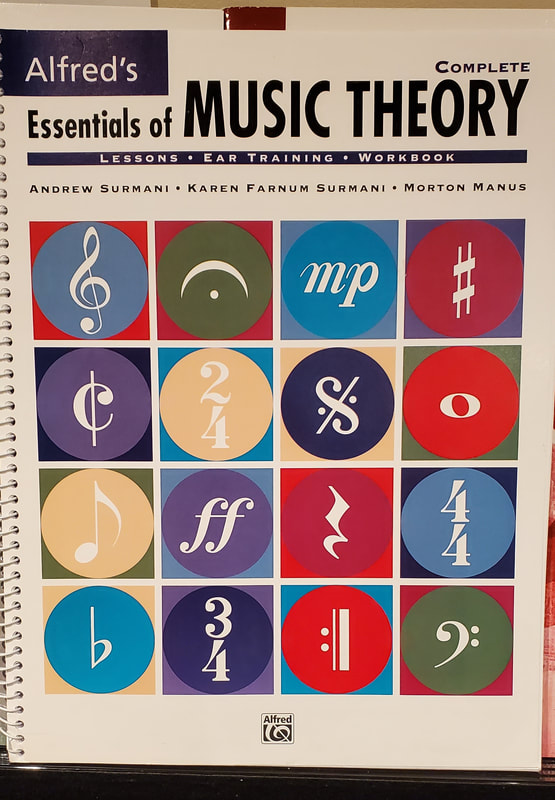
  • For beginners I primarily use Faber and Faber Adult piano adventures. This series teaches music that is attractive to adults, it covers all the important aspects of playing beautifully, and it progresses in a logical way. The Fabers also have a wide range of leveled supplementary repertoire books from classical to jazz and more.  
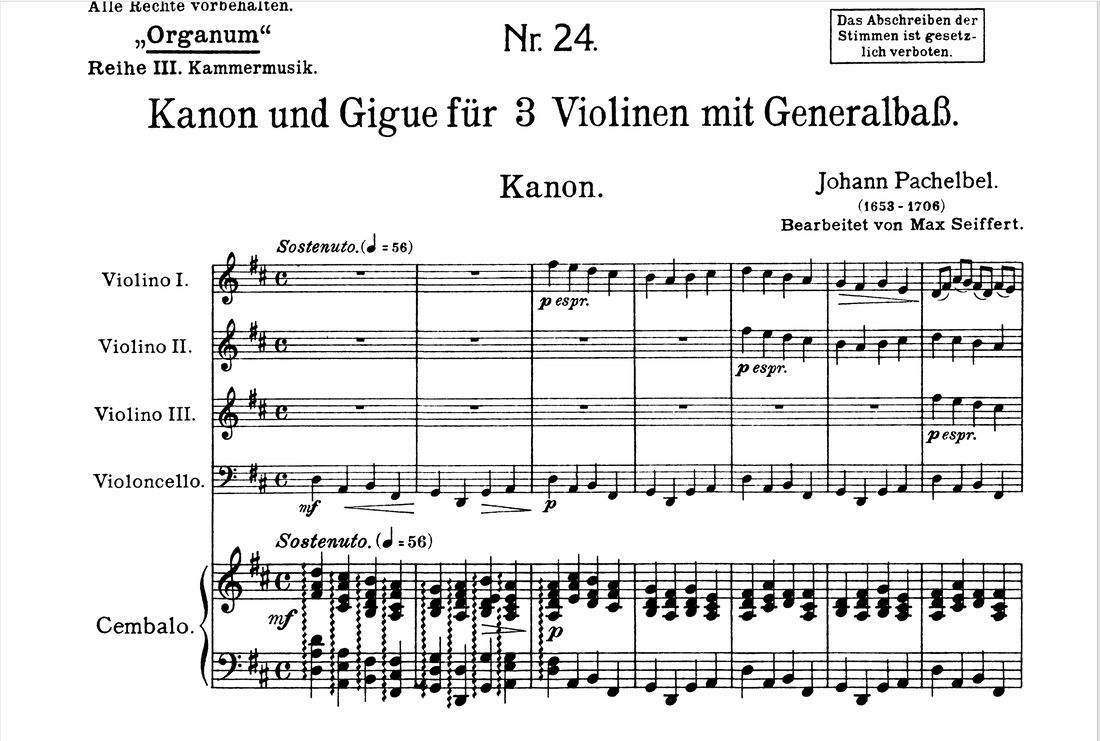
  • For classical music students I primarily draw from the teaching materials of The Royal Conservatory of Music, Toronto. (I graduated from this institution at age 47.)  The curriculum is organized, progresses logically, and when taken seriously, produces musicians who play beautifully from Grade One onwards.   
  • For jazz music students I draw primarily from my own experience performing on stage and my Berklee College of Music background that has been updated with 15 years of tutoring in jazz education from some of the most experienced and renowned jazz educators in the USA and Canada.  

    Proven experience.  
  • Many former students have gone on to careers in music as songwriters, performers, studio engineers, and educators. I’m proud I got them started on a solid footing which, of course, others finished at the college level.  
  • Each year I have several adult students complete piano exams, learn to play in jazz bands, and in general, have a great time playing a wide variety of music from Bach, through Gershwin, to video game music and more.  

    Cheerful service.  
  • I work hard to help students find joy on their piano journey. Learning to play the piano well is not easy, but a cheerful, well organized, and empathic piano teacher is a big help.  

    I have first hand experience in adult learning.  
  • Adult learning is an exciting journey which I understand because I’m on my third voyage. My first voyage, in my forties, was achieving my ARCT pedagogy degree from the Royal Conservatory of Music with multiple scholarships . My second voyage was taking up the drums at age 50. I now play in groups, like the Metropolitain Silver Band (an English brass band in Toronto) and various jazz big bands. And I still take lessons. My third voyage is ongoing. I study daily online at Athabasca University where I am chipping away on a humanities degree with an emphasis on philosophy.  
Picture
0 Comments

What does it take to become proficient in music?

8/12/2024

0 Comments

 
Picture
The loftier your goals, the more time you'll need to invest. However, learning effective practice techniques can speed up your progress. 

Your past musical experiences are also beneficial. For instance, if you've previously learned another instrument, you will find it easier to pick up piano. If it was a positive experience, especially if you have achieved a high level of ability in accomplishment, this is helpful too.  

The resources at your disposal, including financial ones, play a role as well. Both time and money are significant investments in learning the piano. Support and encouragement from family will also influence your journey.  
Understanding the learning process is essential. Familiarizing yourself with how piano lessons are structured will provide insight into the journey ahead and highlight the significance of various study areas, such as repertoire, aural skills, etudes, sight-reading, theory, history, and evaluations.  

Lastly, your eagerness to engage with music outside of lessons will enrich your learning experience. This includes taking part in workshops, attending concerts, exploring music online, and active listening. 

Here's a personal anecdote.

At 50, I began drumming, erroneously thinking this would be easy.  Quickly I discovered it was not. However, I was enamored and all in. Over the last fifteen years, I've studied in four countries with some of today's leading jazz drummers, performed with various community ensembles, took part in New Orleans' second-line parades, and played jazz clubs in Canada, the U.S., Poland, and Italy, as well as many outdoor festivals. Additionally, I now instruct my own students in percussion and study mallet percussion with a symphony musician. The investment of time and money? Large. Yet,
I've achieved my first drumming aspirations, playing in esteemed ensembles of retired professionals and talented hobbyists for audiences beyond just friends and family. Was the journey effortless? Far from it. But was it worthwhile? Absolutely. Would I undertake it again? Indeed, though I'd start at 40. 
 

Did I understand the process? Yes.
Did I practice? You bet.
Did I have moments of discourangment and failure? Yes.
What kept me going? Desire and devotion to the instrument. 
Was it fun? Most of the time.

If you would like help on your piano journey, call me. 

​David


You can read about my retired wife's inspiring violin journey on these blogs.  
0 Comments

I Get Letters

8/9/2024

0 Comments

 
I hope this note finds you in high spirits and with a tune in your heart! I just wanted to take a moment to express my deepest gratitude for the incredible journey of learning piano under your guidance. It's been an absolute pleasure to have you as my teacher, and I am truly grateful for the wisdom, patience, and passion you've shared with me over these last couple of years.

Your ability to break down complex concepts into simple, digestible pieces has made learning piano pure joy. I've always looked forward to our lessons, eager to discover something new.  Your encouragement and belief in my abilities have given me the confidence to tackle even the most challenging pieces.

Thank you, Prof., for being such an exceptional teacher and mentor. Your influence has not only shaped my musical abilities but has also enriched my life in countless ways. I am forever grateful for your time and for the beautiful music you’ve taught me!

Have yourself a lovely well deserved break, see you in September.

With heartfelt appreciation,
Merab
0 Comments

Learning music with friends

8/8/2024

0 Comments

 
Picture
The sociology of group learning and music making.

A short story.

Those of us of a certain age remember that playing in a teenage rock band was a rite of passage in the 1970s. Fueled by macho images, on TV, of rock gods playing to legions of screaming girls ignited our imaginations. With visions of world dominance and female adoration playing in our heads we strapped on guitars, picked up drumsticks, and congregated in shag carpeted suburban rec rooms and formed bands. After a few weeks we had weeded out the hopeless, the nerds, and other misplaced posers. This left the rest of us newly minted teenagers to begin our quest for social significance.  


Here is a timeline.

Year one: We were gawd awful but enthusiastic. We began with Smoke on the Water. We argued and shared bits and pieces of the thing, slowly stitching the thing together. Later, I remember bringing my little radio shack cassette recorder, and proudly recording our band, and listening to it back. Kirby, our drummer was so traumatised that he quit on the spot and was never known to have played again. Even worse it was his rec room, so we needed a new place to practice too.
Year two: The music started to come together. However, there were many more personnel changes over disputes around commitment to the band, artistic differences, and widening skill levels.
Year three: We played in public for the 1st time. Thankfully this was before social media and cell phone video. So, in my memory we were formidable rock gods. (However, I’ve heard some musicians of my early acquaintance play in the last few years, they were gawd awful, which tempers my memory.)
Year four: I’m at Berklee College of Music in Boston and the rest is history.

Postscript.
A few of us from North Bay made it in the end. One of us, the late John McGale, even became a certified rock star and guitar god. And yes, music did take me around the world though not as a rock star. 
 
If you would like to start your quest for music world dominiation, call me, I'll teach you to play. Music lessons were a crucial step we missed back then, we tried to teach ourselves because we were 13 years old and full of self assurance. 

David

0 Comments

Mastering Jazz Piano: The Deliberate Practice Approach

8/7/2024

0 Comments

 
Picture
Thankfully smokey clubs are a thing of the past. Notice what is missing in this Ai generated image of smokey jazz clubs: The lack of diversity. Thankfully the jazz world is no longer segragated.

“Practice makes perfect” if you practice correctly. This blog explores the concept of deliberate practice—a systematic focused and purposeful approach. Here are some ideas to make the most of your practice time. Parallel to the jazz piano suggestion I will illustrate how I use these ideas myself in my quest to master percussion instruments, including the vibraphone.  

1. Have Specific Goals
The first step in deliberate practice is setting clear, specific goals. Forget vague objective like "get better at jazz piano," that is too vague. Try to narrow it down to something tangible. For instance, aim to master a particular jazz standard, improve your improvisational skills, or work on a specific technique.

For example, here are my Jazz Vibraphone meta-goals, and a breakdown of the sub-goals.
I want to be able to jam around town on the vibes with my friends. BTW, my friends are mostly retired professional musicians, so the skill level is high. Skills I need to master.

The skills and tasks are:
a.4 mallet techniques
       i. Block chords
      ii. Hand independence
b. Playing a jazz solo with 2 mallets
      i. Developing my Bebop, swing, and modern vocabulary.
c. Mastering 4 mallet jazz chords
     i. Guide tones
     ii. Rootless 4 note chords
    iii. Idiomatic comping
d. Memorizing tunes on a new instrument

What are your meta goals for jazz piano? What are your immediate goals?
An example of an immediate Goal: Learn to play "Autumn Leaves" with a focus on incorporating ii-V-I progressions smoothly.

My weekly goals or practice regime is:  one transcription of a jazz “head.” Practice comping on tunes I already know. Playing melodies along with professional recordings. Practicing my “licks” in 12 keys, at half tempo.

2. Break It Down
Deliberate practice involves breaking down complex skills into smaller, manageable parts. For jazz piano, this means isolating specific elements of a piece or technique.

Techniques to Focus On:
Chords and Voicings: Practice different voicings for chords in the song. Guide tones, Sonny’s Thumbs (Bebop shells), or rootless voicings!
Scales and Modes: Work on the scales and modes relevant to the piece.
Rhythmic Patterns: Focus on swing feel and syncopation by playing along with recordings.

3. Focused Repetition

Repetition is crucial, but it needs to be mindful and focused. Rather than mindlessly playing through a piece, concentrate on one aspect, or section, at a time. Repeat challenging sections until you can play them effortlessly.

(In my snare drum work, I’ve been isolating a single measure for a few days.)

Practice Routine:
Spend 10 minutes practicing just the left-hand voicings. Devote another 10 minutes to right-hand scales. Combine both hands and play through the difficult measures slowly.

4. Feedback and Adjustment
Effective practice involves constant feedback and adjustments. Record your practice sessions or use a metronome to ensure you're staying in time.

Self-Assessment Tips:
Listen to your recordings and identify areas for improvement. Ask yourself the following question. How is my timing, articulation, and dynamics? Did I play the correct notes? Adjust your playing based on the feedback from the recording you receive. Rerecord and listen again. (There are recording devices on my electronic pianos and drum kits. Do you have one on yours?) I understand how difficult it can be to listen to yourself. But it is well worth the emotional  and psychological pressure to push through the resistance. Here is a suggestion, use headphones.

5. Challenge Your Comfort Zone
Deliberate practice pushes you beyond your comfort zone. If you always play familiar pieces, your progress will plateau. Tackle new and challenging material regularly to keep improving.

New Challenges:

Learn a new jazz standard every month. Experiment with different improvisation techniques. Try playing with backing tracks or in a jam session to apply what you've practiced in a real-world context. (I’m going to a jazz jam this afternoon with my vibraphone and later tonight to a big band practice with my drumkit. Playing with others, as soon as you are ready, is the quickest way to improve.)

6. Rest and Recovery
Finally, deliberate practice recognizes the importance of rest. Your brain needs time to consolidate new skills. Ensure you have breaks during practice sessions and allow yourself to rest between intensive practice days.

Rest Strategies:
Take short breaks every 25-30 minutes. Have at least one day a week without practice to rest your hands and mind. Conclusion

Practicing jazz piano using the deliberate practice model requires a focused and systematic approach. By setting specific goals, breaking down skills, engaging in focused repetition, seeking feedback, challenging yourself, and incorporating rest, you'll see significant improvements in your playing. Remember, the key is not just to practice, but to practice deliberately. Good luck.
 
If I can help you learn to practice, call me.

David

Further reading:
(PDF) How Popular Musicians Learn: A Way Ahead for Music Education (researchgate.net)
Is the Deliberate Practice View Defensible? A Review of Evidence and Discussion of Issues - PMC (nih.gov)

0 Comments

Musical Maxims 2024

7/30/2024

0 Comments

 
One of my college bound pop/jazz students was asking how to improve their opportunities this week. Here is my advice. 
  1. Folk music, like Pop, Jazz, Rock, Acoustic, Country, etc. is played by ear.
  2. Musicians who know the most tunes wins.
  3. Treasure your uniqueness because it is the only way to stand out. Otherwise, you are just a commodity, and commodities are paid at the going rate. 
  4. Spend a significant amount of your time playing along with YouTube recordings to develop feel, time, and endurance.  
  5. Learn to play your instrument. Quote to live by: "If you want to be an Olympian, you must train like one."
  6. Find others to play with as soon as you know a few tunes. Folk musicians develop in informal settings like jam sessions not alone in the library. 
  7. Be easy to work with.
    1. Be punctual
    2. Be presentable
    3. Be reliable
    4. Be cheerful
    5. Know your part
    6. Have your gear in order
    7. Anticipate potential problems and take steps ahead of time to mitigate them. Like, traffic.
  8. Authenticity is key, So stop trying to fake it. 

Classical musicians would have a different list. 

If I can help you, call me. 

​David
0 Comments

I get letters

6/20/2024

0 Comments

 
It goes without saying that David is an accomplished musician on several instruments.  I found him to be an excellent and responsive teacher as well.  I started off thinking I would reconnect with the piano through lessons, but quickly discovered that my heart was no longer in playing a solo instrument.  I asked David if he would help me with ear training instead, as I am singing in several amateur choirs.  Although he was clear that he is not a voice coach, he has an excellent ear and agreed to this change in direction.  He came to each session prepared with something new to work with, including some apps I could use on my phone to build my skills. He created an environment in which I felt comfortable to sing alone and make mistakes.  We used my choir materials to explore some theory concepts, but he also surprised me with his own exercises.  In the end, I feel more confident. I grew musically with his help and encouragement.  His tutelage will allow me to enjoy my choir singing more.  Thank you David!

​NL MacDonald 2024

Thank you, Nona.

0 Comments

How to learn to play a Jazz Solo in 7 easy steps.

6/12/2024

0 Comments

 
When all is said and done there are only a few simple steps one needs to follow. Of course, this means simple to describe and a lifetime to master.
  1. Learn to play your instrument. This seems obvious; however, it must be restated. You will always be limited by your skill at the instrument. On the bright side, those students with rudimentary skills will still be able to express themselves in a jazz manner, it just won’t sound like Oscar Peterson.
  2. Learn and memorise simple jazz tunes ASAP. Then you can concentrate on playing a solo without worrying about whether you will make it to the end of the piece. Reading from a lead sheet and trying to solo at the same time is a complexity you want to avoid. The following titles are a good start. 
    1. Autumn Leaves
    2. C jam blues
    3. Blue Bossa
    4. Summertime
    5. Satin Doll etc.
  3. Practice playing the tunes with the original recordings. This is the key to acquiring a good solid jazz feel. With good feel and rhythm playing a solo is soooo much easier. This is because with good rhythm even wrong notes will sound good or great. Start by just playing the melody with the recordings and work up from there.
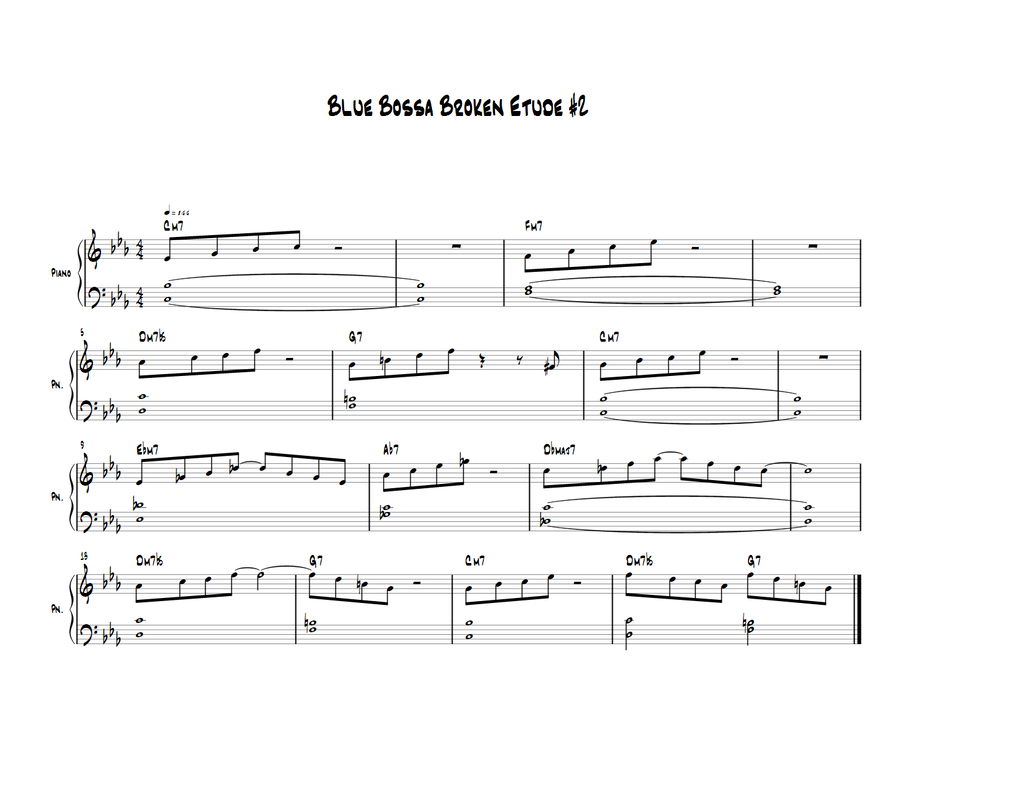
  4. Practice the broken chords of your pieces in the right hand because jazz solos are built on these patterns.
  5. Learn some simple blues licks and transpose them to the keys of C, F, Bb, and Eb. These are keys you are going to be working in as a jazz musician.
  6. Start transcribing, no matter how rudimentary your efforts might be. My 1st lick was repeated 8th notes in octaves for 4 measures in the Doobie Brother’s, China Grove.”. I was thrilled! I’ve played that lick for half a century. Check it out.  https://youtu.be/RX7iHsAIw9o?si=E4BzN9aau21kJ_MB
  7. Practice jazz solo patterns over the chords in your pieces. Find a zillion patterns here:  jazz solo patterns - Search (bing.com)

Another perspective from Louis Armstrong. A Perspective that works every time. 

1. Memorize the melody. 
2. Mess with the melody. 
3. Mess with the mess. 

If I can help you, call me. 
​David
0 Comments

Deliberate Practice June 2024

6/12/2024

0 Comments

 
Picture
Books and Websites on deliberate practice
  1. Peak by Anders Ericsson and Robert Pool. This book explains the science and principles of deliberate practice and how to apply them to any skill. Ericsson is the scientist who began a systematic exploration of the subject. 
  2. The Talent Code by Daniel Coyle. This book explores how deliberate practice, motivation, and coaching can unlock the potential of anyone. I found this book encouraging. 
  3. Bulletproof Musician | The Science (and Art) of Peak
  4. PerformancePodcast 052 - Benny Greb: Better practice, better results. (drummersresource.com) A hilarious interview with the author of the book above. 

​Happy Practicing. 

David


0 Comments

Chick Corea and Thelonious Monk give advice.

5/17/2024

0 Comments

 
Picture
Picture
0 Comments

Cross Hand Chord Exercises

4/29/2024

0 Comments

 
Picture
Download Key of A
Download key of c
Download Key of B flat
Key of A flat
Picture
Free Download in C
Free download in F
Free Download in g
0 Comments

1.    Deliberate practice and the violin

4/20/2024

0 Comments

 
Picture
​1.    Deliberate practice 
I have always listened to classical music, which I have loved since I was a child. My father listened to opera; he loved Beethoven. He knew nothing more than he liked this music and I never thought to ask him how he had met it in Sydney, Nova Scotia, growing up in the great depression on the wrong side of town. Growing up in the Maritimes I was also exposed to fiddle music as a fundamental feature of Maritime culture. And, of course, my coming of age coincided with the great folk festivals of the late 60s and the dynamic rock revolution of the 70s and 80s. Suffice to say, I have familiarity with a broad spectrum of musical genres.
 
I progressed doggedly, passing my grade 1 examination, 7 months later (95). Playing before an examiner was, as Rory had voiced a couple of years ago, an intimidating experience. There is you and your violin and the marker and nowhere to hide. As a professor, I was used to making presentations before audiences of diverse sizes from a few people to hundreds. But I spoke about material that I had researched, taught, and written about as an expert in my field. I supported my talks with fancy, attention grabbing multimedia. I got to stand behind a lectern. I was never as exposed as I was playing the violin for an audience.
 
Just playing for my teacher could make me break out in a cold sweat. But music is meant to be played with and for others, so performance is an essential skill. I had to practice performance as well the many physical skills intrinsic to playing a musical instrument.
 
When I visited family in the Maritimes, I played for my mother in hospital (woe betide anyone else trapped in the same room). My brother would groan. My sister would praise my efforts, and acidly remark that no other 60 year old in the family seemed to be learning anything quite so difficult. My 90 year old mother would ignore her sniping children and merrily sing along. So would my daughter, in support of her grandmother slowly fading with dementia. I accumulated tunes I picked out by ear that mom could still sing: Frère Jacques, Row, row, row your boat, Old MacDonald had a farm and suchlike. I sent a tune a week to my sister (mom’s caretaker) to play to her. This became my weekly learning-by-ear project.
 
On trips to visit David’s parents, both musicians, we gave concerts. Playing with David made me sound so much better. My father-in-law, a cello player and a choir singer with a practiced ear made the suggestion that I sing along to my playing for a check on pitch fidelity. Though I am not sure my singing is any kind of asset, singing in your head really helps to hone pitch, a necessity in playing any unfretted stringed instrument. It was a good call.
 
The term “deliberate practice” I was familiar with, but it wasn’t until my list of scales and études grew too onerous to plow through daily that I had to schedule what I could and should do on a given day. This reshaped my practice, which by that point had grown from a half hour to 45 minutes stretching into an hour daily. I had to choose scales matching the requirements of the études and repertoire pieces, and make sure that I managed to do everything over the course of a couple of days. By the time I reached level 4, I had a grid outlining four days of technical studies: scales, arpeggios, double stops, which themselves followed left hand and bow warm-ups and preceded études and a selected repertoire pieces. Within each section, I had specific practice points. The job was to try to focus on one thing at a time—dynamics, pitch, expression, slow bowing, clean string crossing, and more, though I had to be responsible for everything in the end. Violin learning is intensely physical as well as cognitively demanding and aesthetically challenging. Practice is complex.
 
I have remained with the same teacher, an excellent critic, demanding of attention to details and a seemingly endless font of advice on how to do sometimes minute things that contribute to violin playing. She is a concert violinist, who teaches. Now retired, I can be flexible with her timing, but I am constant. Even on weeks when I feel I have acquired absolutely nothing in practice, we have our lesson. Sometimes it is highly informative. Sometimes I feel like a four year old who can’t tie my own shoelaces. Always it is a learning experience. Nine months following my Level 1 exam, I passed Level 2, (88), and a year after that, Level 3 (87). Lucia was frank: the period of preparation gets longer with each level and the marks slide with the increasing level of complexity. I am hoping to be ready for my Level 4 exam in a month or two and have extended my preparation accordingly. Lucia says, there is no hurry.
 
I now practice once or twice a day for an hour to an hour and a half. I stretch and roll out tight muscles to keep as much fluidity as possible playing an instrument infamous for causing neck and back pain. Five years after that first birthday gift of a rental violin, I treated myself to a handmade carbon fibre violin that I fell in love with. I have upgraded my wooden violin and acquired two quality bows: a carbon fibre for fiddle music, and a pernambuco wooden bow for best tone in classical music. The idea that I might stop playing is now ludicrous—this is an immense journey and I have got this far. There is no turning back!
 
My teacher says, you can become a doctor in 7 or 8 years, but it takes a lifetime to become a musician. I still resist beginning my practice some days when listening to myself is depressing, though less so than in the early days, when dogged repetition was required to get anywhere at all. I now also take fiddle classes in addition and sometimes play fiddle tunes with friends who are more advanced but gracious and tolerant. Come to think of it, my pitch is better than some of the other fiddlers who haven’t paid such close attention to detail as I have had to with private lessons. I am working on vibrato which I find fearfully difficult. Lucia reassures me. This is a long process. Just keep working every day and slowly, there will be progress.

​Heather Lotherington

Part 1
Part 2
Part 3
Part 4
0 Comments

1.    Committing to the instrument!

4/20/2024

0 Comments

 
​1.    Committing to the instrument! 
I made the first of my solid commitments to learning to play the violin in the early months of my learning journey (before the beginning of the pandemic) when I returned my inexpensive rental instrument to Long & McQuade, and went to The Sound Post to buy my very own violin. Terrified to showcase my elementary playing skills, I asked the salesclerk to play the array of violins he had picked out that were within my price range. This he gladly did—perhaps not for the first time, I thought. After all, a sale is a sale.
 
Buying a stringed instrument and/or a bow carries a trial period. My teacher, Lucia, had made it very clear that I would need to play a new instrument for a while to know if it felt right. My criteria for feeling right were rather slim at this stage, so I chose the most resonant violin complete with case and bow, and just looked at it for a while when I got it home. It was a lovely student violin and it got me through the first few years of learning.
 
My problems at this stage of learning—level 1—were myriad: I had insufficient strength in my fingers (to hold down the strings) and back (to hold up the bow without tension) and lacked the requisite flexibility in my shoulders, arms, hands and wrists to reach all the notes on a violin. My joints slowly opened up as I strove to reach hard to hit notes and press hard enough on the string to make a good sound—or maybe any sound. But this did not happen overnight, and trying too hard just caused more stress injuries. Listening to myself was still unutterably dismal and horribly demotivating but I just kept pushing through on blind faith.
 
When I received the final mark on my embossed RCM assessment for the preparatory level, I wondered for a moment, if they might have sent the result to the wrong person. 91? First class honours with distinction? I was amazed!
 
With this positive reinforcement, I launched headfirst into Level 1. On the technical side, I graduated to A minor harmonic (check!) and A minor melodic, which was a scale I had never heard of before. The dreaded C major scale made an appearance. I also had G major—on two octaves. There would no longer be any excuse for avoiding the G string. Not only did I have to learn the G scale starting on the open string, the lowest note on a violin, but the C scale began on the G string with the third finger. No tonal reference point. Tricky!
 
There were also double stops: playing two strings at the same time. These were open strings: perfect fifths. They sounded beautiful but it was devilishly difficult to balance on both and keep the hee-haw sounds down. Turning the page to the études, I saw a definite escalation. My studies included pieces with accidentals, double stops, harmonics, slurs over four notes (oh come on!) and sixteenth notes, though fortunately not altogether in the same place. They presented a kind of choose your poison smörgåsbord.
 
I sat, listened and read along to every piece in the repertoire book, all played by professional violinists who sounded hopelessly perfect and beautiful. I tried to judge the most doable pieces for myself. These were not necessarily the easiest, but I did not want pieces deliberately pushing the boundaries of the next level. Showboating is for young people with good joints and easy flexibility, who also play on proportionately smaller violins. No such luck for seniors.
 
I listened for something else, too: I wanted to play what I liked. There was a wide variety of pieces offered, so this was not hard. I met composers, such as Dmitri Kabalevsky, whose compositions I loved, and found traditional songs, such as, Un Canadien errant, a beautiful, haunting piece that I have known since childhood. I found a lovely ballad written as a duet, and asked Lucia to record the second violin. When she sent it and I played along, magic happened. Playing against a beautifully performed second violin made my first violin part sound so much richer. I played and played that piece. I still play it years later to practice more advanced techniques, such as vibrato. Cycling back to earlier pieces to practice new skills, coincidentally a feature of the Suzuki method, was reassuring and affirming of my progress.
 
Thus far, I had organized my daily practice in terms of a linear run through the technical exercises, studies (now two of them) and selected repertoire pieces. Though still generally useful as an organizing principle, linear study was becoming physically unrealistic. I needed to learn to do deliberate practice. 
Part 1
Part 2
part 3
part 5
0 Comments

My (heart-attack inducing) preparatory violin examination

4/20/2024

0 Comments

 
Picture
​1.     My (heart-attack inducing) preparatory violin examination 
When my teacher, Lucia, thought I was ready for the examination, about 6 months in, I nervously opened the appropriate account on RCM and applied for an examination date and time, choosing a time when my playing would not disrupt any of David’s regularly scheduled musical activities and he could accompany me on the two repertoire pieces. I chose 9:30 am, giving me enough time to wake up, eat, warm up, and—recommended by Lucia—retune my violin to the conditions of the basement where the zoom exam would be held.
 
A month before the examination my nerves started getting the better of me, so I intensified my practice time on the weekends, bearing down on my scales and arpeggios, determined to get my fingers in the exact place for each note. A millimetre up or down the string produced disharmony, yet there are no guiding frets on a violin. I practiced as diligently as I could: open string bowing, scales, arpeggios, get that fourth finger in place ahead of time! I got my teacher to give me a mock exam during lesson time. It was humiliating.
 
The week before the exam, my pieces were running on a constant loop in my head. I practiced my fingering while I slept, when I slept, which was seldom and badly. I practiced maniacally. I worked out every kink in continual mock Zoom exams, doubling down on the bits I flunked. Rory, the bass player, over to play in the Wednesday jazz trio at our place, asked whether I had ever played in front of an audience, incredulous that I would be doing a violin exam. Well, my in-laws, I said shakily, and I am a professor with a lifetime of public speaking behind me. Yeah, well this is different, he said, looking at me with concerned amazement. This was not confidence building.
 
Two days before the exam, I felt that I had now learned the elements of preparatory violin, and performance of these basics was up to the vicissitudes of exam performance where, of course, anything can happen. I had memorized my repertoire pieces and, though not necessary, my étude as well. My scales were on autopilot. I felt that it was essential to credit myself with accomplishment of this basic learning and damn the torpedoes. I was ready for the exam.
 
The morning of the exam, I ran around in circles preparing: my violin needed to be acclimatized to the humidity of the basement. I needed to ensure that the piano and the violin were exactly in pitch. Was there enough rosin on the bow? David and I practiced our simultaneous piano and violin start: an audible breath, really a sniff, and tally ho. I entered the zoom waiting room nervously. We were being recorded though no one was there. I thought I would wet my pants waiting for the zoom examiner to show up.
 
And suddenly there she was with a friendly face. I silently thanked the heavens above that I had been spared a hangman, and greeted her so exuberantly, she must have thought me a little simple. I started by playing open strings just so we could adjust any controls on our respective technological connections for best sound and to check that my instrument was in tune. All the same, my fingers trembled, my sweat glands went into overdrive, and I forgot how to breathe. I did remember to smile and to play with the conviction my teacher had taught me to show. There were to be no faces pulled, indicating disappointment or frustration, and if I made a booboo, I was to make it with pride and move on.
 
I began with my scales, and true to practice, practice, practice, they rolled off just fine. My étude began a little flat but it had spirit. My teacher had told me to sing my repertoire piece, entitled (appropriately), Song, to make up words, create a story and tell it in music. She told me to play what I heard in my head not what I produced with my fingers. So I did. My fast piece, the last in my program, was intended to be humorous, and it flowed with sheer relief. Whew! Then, adrenaline draining, I started to fade. I managed the ear training tests but goofed on one of my playbacks, exacerbating the mistake by apologizing and misnaming the note I had missed. The examiner smiled gently and thanked me for playing for her. The whole thing had lasted about 7 minutes.
 
I regained my composure and my blood pressure slowly receded from the stroke zone as the morning wore on, though the excitement of the exam had been surprising. Later in the day I presented the annual review of our faculty’s innovative research intensification strategies to the Council of Associate Deans of Research across my university. In comparison, it was a cakewalk.
 
In celebration, I bought the level 1 violin books and listened to all the pieces in the repertoire book. It was a week or two later when I got my assessment. I had indeed lost a point on my playback. Oh well. I had learned everything from memory (not a significant effort when all pieces are one page long) so I got full marks for that. The examiner was very generous in her assessment of my pitch and dynamics, and the work cut out for me was in relaxing my wrists and connecting the bow a little more solidly on the string. I had passed. Her commentary was clearly positive, though somewhat opaque to me as a rookie: “There is a very sweet tone colour here…Glissando is well attempted.” I kind of got the gist. But the mark surprised both of us…
part 1
part 2
part 4
part 5
0 Comments

The Power of the Talking Metronome

4/19/2024

0 Comments

 
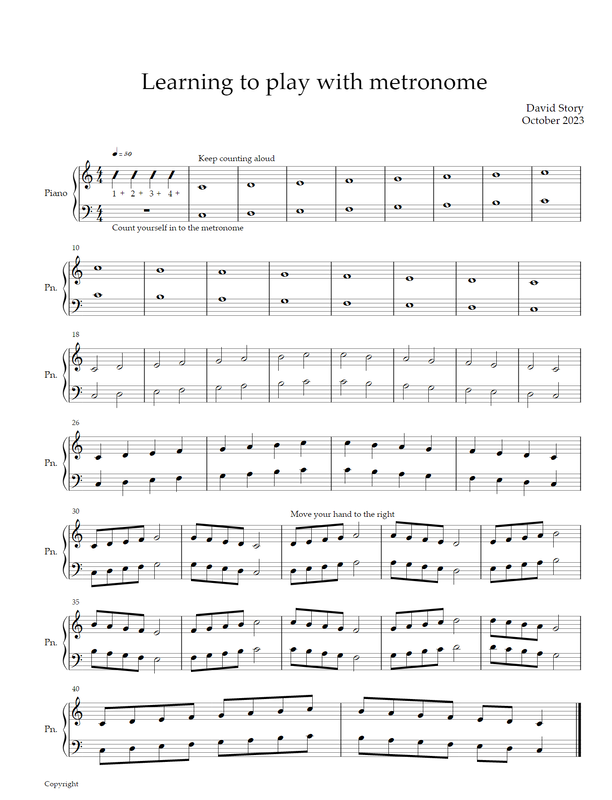
This will help you play in time. (1) talking metronome - YouTube You can easily search the tempo and time signature you need. The 1st collection counts in quarter notes, the 2nd in 8th notes, and the 3rd in 16ths. Other time signatures can be found on their YouTube channels. 
0 Comments
<<Previous
Forward>>
    You've got to learn your instrument. Then, you practice, practice, practice. And then, when you finally get up there on the bandstand, forget all that and just wail.
    Charlie Parker

    Author

    I'm a professional pianist and music educator in West Toronto Ontario. I'm also a devoted drum set and mallet percussionist. 

    Archives

    January 2026
    December 2025
    November 2025
    October 2025
    September 2025
    August 2025
    June 2025
    May 2025
    April 2025
    March 2025
    January 2025
    December 2024
    November 2024
    October 2024
    September 2024
    August 2024
    July 2024
    June 2024
    May 2024
    April 2024
    March 2024
    February 2024
    January 2024
    December 2023
    November 2023
    October 2023
    September 2023
    August 2023
    July 2023
    June 2023
    May 2023
    April 2023
    March 2023
    February 2023
    January 2023
    December 2022
    November 2022
    October 2022
    September 2022
    August 2022
    July 2022
    June 2022
    May 2022
    April 2022
    March 2022
    February 2022
    January 2022
    December 2021
    November 2021
    October 2021
    September 2021
    August 2021
    July 2021
    June 2021
    May 2021
    April 2021
    March 2021
    February 2021
    January 2021
    December 2020
    November 2020
    October 2020
    September 2020
    August 2020
    July 2020
    June 2020
    May 2020
    April 2020
    March 2020
    February 2020
    January 2020
    December 2019
    November 2019
    October 2019
    September 2019
    August 2019
    July 2019
    June 2019
    May 2019
    April 2019
    March 2019
    February 2019
    January 2019
    December 2018
    October 2018
    September 2018
    August 2018
    July 2018
    June 2018
    May 2018
    March 2018
    January 2018
    December 2017
    November 2017
    September 2017
    August 2017
    July 2017
    June 2017
    May 2017
    April 2017
    March 2017
    February 2017
    January 2017
    December 2016
    November 2016
    October 2016
    September 2016
    August 2016
    July 2016
    June 2016
    May 2016
    April 2016
    March 2016
    February 2016
    January 2016
    December 2015
    November 2015
    October 2015
    September 2015
    August 2015
    July 2015
    May 2015
    April 2015
    March 2015
    February 2015
    January 2015
    December 2014
    November 2014
    October 2014
    September 2014
    August 2014
    July 2014
    June 2014
    May 2014
    April 2014
    March 2014
    February 2014
    January 2014
    December 2013
    November 2013
    October 2013
    September 2013
    August 2013
    July 2013
    June 2013
    May 2013
    April 2013
    March 2013
    February 2013
    January 2013
    December 2012
    November 2012

    Categories

    All
    Adult Piano Lessons
    Blues Piano
    Breakfast Piano Minute
    Buying A Piano
    Children's Piano Lessons
    Classical Piano
    Ear Training
    Goal Setting
    Hobby Overload
    How To Practice Scales On The Piano
    Jazz Chops
    Jazz Piano
    Learning Classical Piano
    Learning Piano
    Learning Resources
    Motivation
    Music Practice
    Piano Exams
    Practice Organization
    Practicing Piano
    Starting Piano
    Stories
    Summer Piano Lessons
    Technique
    Theory
    Time Management
    Virtual Piano Lessons
    What Students Are Playing This Week

    RSS Feed

                                                ©2025 David Story
  • Homepage
  • Tips, Ideas, Stories, Free Lessons
  • Contact form, fees, calendar, policies
  • Adult Lessons
  • About Me
  • Children Lessons
  • Jazz and Blues Workshops 2024 2025
  • Philosophy
  • Testimonials
  • Student awards and compositions
  • Classical downloads
  • Classical outline for beginners
  • Jazz and Blues Downloads
  • Jazz outline for beginners
  • Children's Piano Recital
  • Video Library of Piano Techniques
  • Breakfast Piano Minute
  • Books, Apps, Websites, Music
  • Ear Training and Sight Singing Resources
  • My YouTube channel
  • Chord Voicings for Jazz Standards
  • Long and McQuade Teacher Workshop 2024